
Every Diwali, money and gifts change hands: envelopes from elders, sweets from neighbours, a gold coin from a friend, a hamper from a client. Almost none of it is taxed, and nobody should be worried about a box of dry fruit. But the law does draw a line, and it sits somewhere most people do not expect. The rule is not about the occasion or the size of a single gift. It is about who gave it and what kind of thing it is.
The rule, and where it now lives
Gifts received without paying for them are taxed under what used to be Section 56(2)(x) of the old Act and is now section 92 of the Income-tax Act, 2025, in force from 1 April 2026. Anything that falls inside the rule is added to your income as 'income from other sources' and taxed at your slab rate.
Source: Income-tax Act, 2025, section 92(2)(m), (3) and (5)
Who can give you anything, tax-free
- Relatives, with no limit at all: your spouse, brothers and sisters, your spouse's brothers and sisters, your parents' brothers and sisters, anyone in your direct line up or down (parents, grandparents, children, grandchildren), the same direct line on your spouse's side, and the spouses of all of these.
- Gifts received on the occasion of your own marriage, from anyone.
- Anything received under a will or by inheritance.
Notice who is missing from the relative list: cousins, friends, neighbours, colleagues and clients. A gift from your cousin is treated exactly like a gift from a stranger.
What counts, and what does not
From non-relatives, the rule covers money, and a specific list of property: land or buildings, shares and securities, jewellery, bullion, paintings, sculptures and other works of art, archaeological collections, and crypto and other virtual digital assets. A watch, a phone, clothes, sweets or a hamper are not on that list, so this rule does not tax them.
The limit almost everyone gets wrong
- The ₹50,000 limit is for the whole tax year added together, not per gift and not per person.
- Cross it and the entire amount becomes taxable, not just the part above ₹50,000.
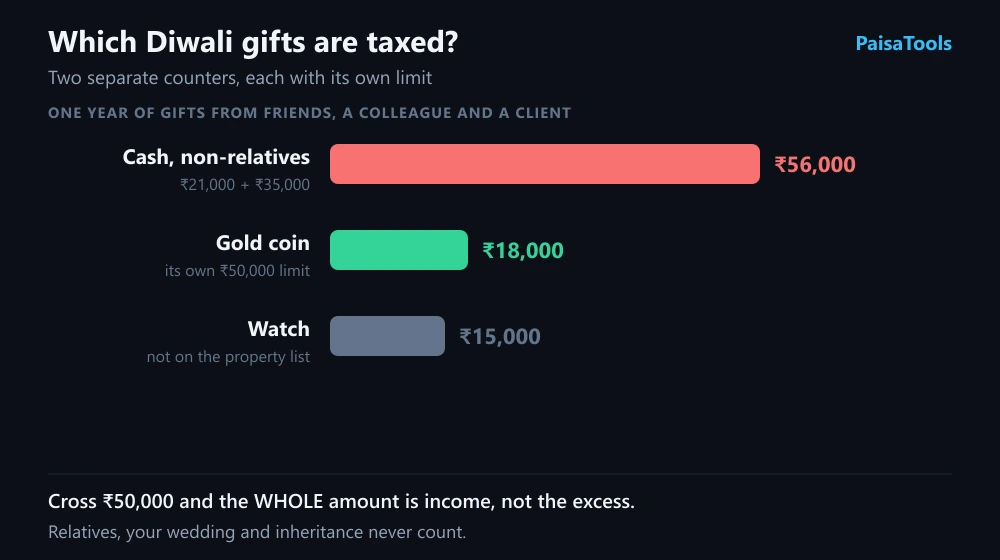
- Money and movable property are counted separately. Cash from non-relatives is added up on its own, and the market value of jewellery, bullion, shares and the rest is added up on its own, each against its own ₹50,000.
An example. Over the year, friends give you ₹21,000 in cash, a colleague gives you a gold coin worth ₹18,000 and a client a ₹15,000 watch. Nothing is taxable yet: the cash is under ₹50,000, the coin is under its own ₹50,000, and the watch is not covered. Then a family friend sends ₹35,000 for Diwali. Your cash total is now ₹56,000, so all ₹56,000 is added to your income. In the 30% slab that costs ₹17,472 with cess; in the 20% slab, ₹11,648.
Three situations that work differently
- Gifts from your employer are not covered by this rule. They are taxed as a perquisite under separate limits; our Diwali bonus post explains how much is tax-free.
- A gift from a client because of your work can be business or professional income rather than a gift, and is taxed as such regardless of the ₹50,000 limit.
- Giving money to your spouse is tax-free when you give it, but the income it later earns, such as FD interest, is normally added back to your own income under the clubbing rules.
Cash has a separate ceiling
Even when a gift is completely tax-free, nobody may receive ₹2 lakh or more in cash from one person in a day, or for a single event or occasion. This is Section 269ST of the old Act, now section 186 of the Income-tax Act, 2025, and the penalty falls on the person who receives the cash. A large Diwali or wedding gift from a relative is still better sent by bank transfer, which also leaves a record if the tax department ever asks.
- Keep a note of any large gift: who gave it, the relationship, the date and the amount.
- For a sizeable gift of money or shares, a simple signed gift letter from the giver helps.
- If you crossed the limit, show the amount under income from other sources in your return.
Frequently asked questions
- Are Diwali gifts taxable in India?
- Only some. Gifts from relatives, on your marriage or by inheritance are never taxed. From non-relatives, cash and listed kinds of property such as jewellery, bullion and shares become taxable if their yearly total crosses ₹50,000, and then the whole amount is taxed.
- Is the ₹50,000 limit per gift?
- No. It is the total received in the tax year from all non-relatives, and money and movable property are each totalled against their own limit.
- Is a gift from my cousin tax-free?
- No. Cousins are not in the legal definition of relative, so a gift from a cousin is treated like a gift from a friend.
- Is a gift from my employer covered by this rule?
- No. Employer gifts are taxed as a perquisite under separate rules, not under the gift rule.
- Can I receive a large cash gift from my father?
- It is tax-free, because a parent is a relative, but you cannot receive ₹2 lakh or more in cash from one person in a day or for one occasion. Use a bank transfer for large amounts.