
"Is this a good salary?" is one of the most-searched money questions in India — and the honest answer is: it depends on three things, one of which most people forget. Here's a realistic benchmark, without the LinkedIn-flex inflation.
The honest averages
Two figures get quoted for this and they are nowhere near each other, so the one you happen to read decides whether you feel behind or comfortable. The average is dragged upward by a small number of very high earners and describes almost nobody. The median — the middle salary, where half the country earns less — is the honest one, and it sits far below the average people usually cite. Here are both, and the gap between them is the point: the average runs to roughly ₹7-9 lakh a year, about ₹55,000-75,000 a month before deductions, while the median sits closer to ₹30,000-35,000 a month. Clear ₹50,000 a month in hand and you are already ahead of most of the country.
By experience
A fresher in a tier-2 city typically starts around ₹15,000-25,000/month; with 3-5 years of experience, ₹50,000-75,000/month is a genuinely good range; and senior professionals in high-demand fields (tech, finance) in metros can reach ₹1.5-3 lakh/month. Your first few years matter less for the number and more for the skills that compound it.
By city — because cost of living changes everything
₹80,000/month in Bengaluru or Mumbai is not the same as ₹80,000 in a tier-2 city, where rent and expenses can be half. A 'good' salary in a metro (₹60k-1L+/month) buys the same life as a smaller number elsewhere. Always judge a salary against your city's rent, not a national average.
By city and family size: what each household actually needs
A 'good' salary is really a question about who it has to support. The rows below turn household shapes into the monthly take-home they need and the CTC a single earner would need to deliver it, with one rule throughout: cover the household's spending and still save 20% of take-home. CTC is converted with FY 2026-27 new-regime rules, Basic at 50% of CTC, and employer PF and gratuity removed first. Every spending figure is an assumption, so swap in your own.
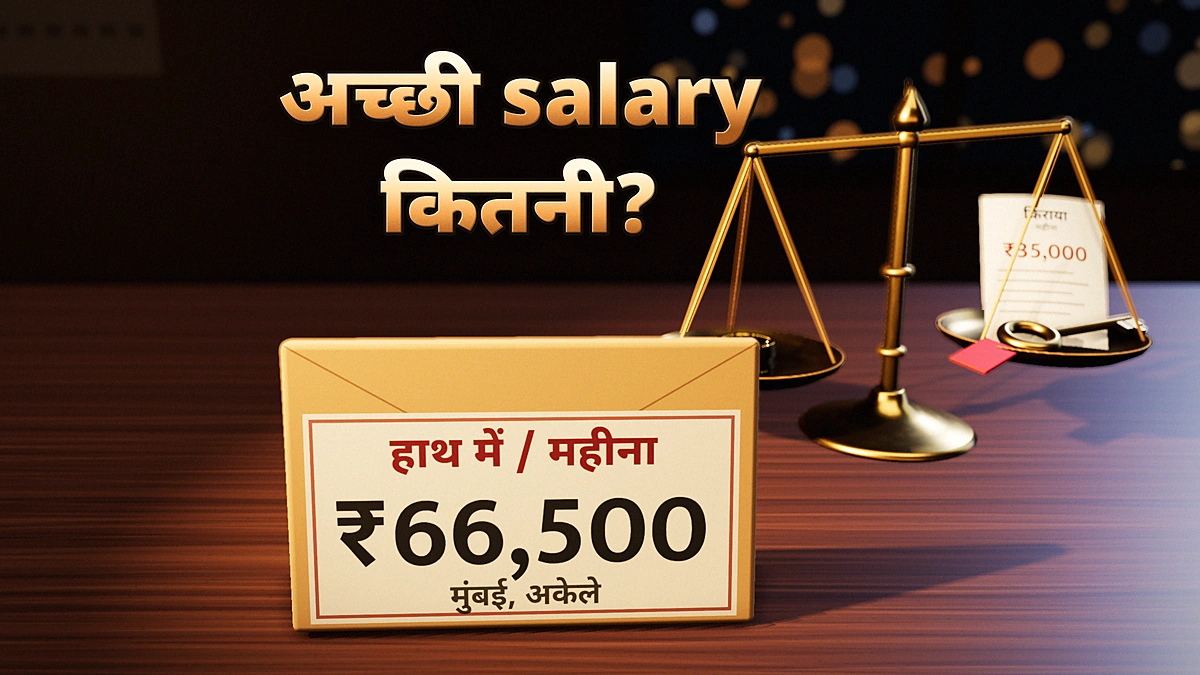
- Single, metro: Mumbai rent of ₹35,000 plus ₹18,000 of essentials → about ₹66,500 in hand → about ₹9.4 lakh CTC. Bengaluru → about ₹8.2 lakh.
- Single, smaller city: Indore rent of ₹12,000 plus ₹18,000 → about ₹37,500 in hand → about ₹5.4 lakh CTC.
- Couple, no children, metro: assume ₹30,000 rent plus ₹30,000 for everything else → ₹75,000 in hand → about ₹10.5 lakh CTC for one earner.
- Couple, no children, smaller city: assume ₹13,000 rent plus ₹28,000 → about ₹51,000 in hand → about ₹7.2 lakh CTC.
- Family of four, metro: ₹83,000 to ₹1.7 lakh of monthly spending → ₹1.04 lakh to ₹2.1 lakh in hand → roughly ₹15.6 lakh to ₹37 lakh CTC if one person earns it all.
- Family of four, smaller city: ₹50,000 to ₹1 lakh of spending → ₹62,500 to ₹1.25 lakh in hand → roughly ₹8.8 lakh to ₹19 lakh CTC for a single earner.
Two things stand out. Children move the number more than the city does: a family of four in a smaller city, even at the lean end of its budget, needs about the same CTC as a single person in Mumbai. And the family rows are where a second income stops being a luxury. Split across two earners, the metro family's lean-end budget needs two CTCs of about ₹7.3 lakh each rather than one of ₹15.6 lakh, and the pair pays less tax doing it, because each income sits in a lower slab.
The CTC you need in eight Indian cities, worked throughWhere does your salary rank in India? Mera Rank (CBDT data)The trap: a good CTC isn't a good in-hand
This is the part that catches people. A ₹12 lakh CTC sounds great, but after employer contributions, PF, professional tax and income tax, your in-hand is about ₹84,000–90,000/month under the new regime, not ₹1 lakh. Two offers with the same CTC can pay very different take-home depending on structure. Before you call a salary 'good', convert the CTC to actual in-hand.
What actually makes a salary good
The real test isn't the number — it's the gap between what you earn and what you spend. Someone earning ₹60,000 and saving ₹20,000 is doing better than someone earning ₹1.2 lakh and saving nothing. A good salary is one that comfortably covers your needs and still leaves room to invest every month. Grow the income, keep lifestyle steady, and invest the widening gap.
The test that matters: does the salary build wealth?
The other way to judge a salary is what its savings turn into. Take 20% of the in-hand pay at each CTC, invest it every month at an assumed 12% a year, and see how long it takes to reach ₹1 crore - first with a flat SIP, then with the SIP raised 10% every year as pay rises:
- ₹6 lakh CTC → about ₹42,600 in hand → ₹8,500 a month → ₹1 crore in about 21 years (17 with the step-up)
- ₹9 lakh CTC → about ₹64,000 → ₹12,800 → about 18 years (14.5)
- ₹12 lakh CTC → about ₹85,400 → ₹17,100 → about 16 years (13)
- ₹18 lakh CTC → about ₹1,18,100 → ₹23,600 → about 14 years (11)
- ₹24 lakh CTC → about ₹1,51,000 → ₹30,200 → about 12 years (10)
Quadrupling the CTC cuts the wait by only about nine years. The savings rate and the start date do more of the work than the salary itself, which is the honest answer to whether a salary is 'good': it is good if it leaves a gap you actually invest.
Read next (Hindi): 1 करोड़ कैसे बनाएं — the SIP by starting ageRead next (Hindi): पैसा डबल कैसे करें — the Rule of 72, honestlyRead next (Hindi): कितने साल में पैसा डबल होता है — after tax and inflationStep-Up SIP Calculator — raise the SIP with every incrementIn-Hand Salary Calculator — turn any CTC into real take-homeRead next: CTC vs in-hand vs gross vs net salaryRead next: what a middle-class family actually spends each monthCTC to in-hand salary, worked out step by step (Hindi)Frequently asked questions
- Is ₹80,000 a month a good salary in India?
- By the numbers, yes. ₹80,000 a month is ₹9.6 lakh a year, more than about 73% of salaried income-tax return filers (CBDT ITR statistics, AY 2023-24) and about 3.8 times the ₹21,103 a month that the average salaried worker earned (PLFS 2023-24). Under the new regime a salaried person pays no income tax up to ₹12.75 lakh, so most of it stays in hand after PF. Whether it feels good depends on your city and family size, covered above.
- What is a good salary in India per month?
- As a rough benchmark, ₹50,000-1,00,000/month in-hand is considered good, especially in metros — it's above the national median of roughly ₹30,000-35,000/month. But 'good' depends heavily on your city's cost of living and your savings rate, not just the number.
- Is ₹30,000 or ₹50,000 a month a good salary in India?
- ₹30,000 a month is about the national median (roughly ₹30,000-35,000), so it is an average salary, not a low one. Clear ₹50,000 a month in hand and you are ahead of most of the country. Your city and savings rate decide the rest: a single person needs about ₹37,500 in hand in Indore and about ₹66,500 in Mumbai to cover costs and still save 20%.
- Is ₹6 lakh or ₹10 lakh a good salary in India?
- ₹6 lakh CTC is a solid early-career salary; ₹10 lakh is comfortably above average. But remember these are CTC figures — the in-hand is lower after PF and tax. Check the actual monthly take-home before judging, and weigh it against your city's expenses.
- What is a good salary for a family of four in India?
- On line-by-line 2026 budgets, a family of four spends roughly ₹83,000 to ₹1.7 lakh a month in a metro and ₹50,000 to ₹1 lakh in a smaller city. Saving 20% on top means a household take-home of about ₹1.04-2.1 lakh in a metro and ₹62,500-1.25 lakh elsewhere.
- Is ₹1 lakh a month a good salary in India?
- In hand, yes for most households - it is about three times the national median. It covers a single person or a couple comfortably in any city, but sits at the lean end for a family of four in a metro, where budgets commonly run ₹83,000 and up before savings.
- What makes a salary 'good'?
- Less the headline number, more the gap between income and spending. A salary that covers your needs and still lets you invest every month is a good one. Someone earning less but saving 30% is often better off than a higher earner saving nothing.