
A claim rejection arrives at the worst possible moment — usually while someone is still in hospital, or just after the family has paid the bill themselves. Most people read the letter, feel cheated, and stop there. That is exactly what the process counts on.
There is a defined escalation path, it costs nothing, and at the end of it sits an authority whose decision the insurer must follow. Here is the order, and what each step needs from you.
First, find out what they actually said
A rejection letter must state the reason and the policy clause it relies on. If yours does not name a clause, that is your first question in writing. The common reasons are narrower than they sound:
- Waiting period — the condition is covered, but not yet. Specified illnesses and joint replacements usually wait two to four years.
- Pre-existing condition not disclosed when the policy was bought.
- Treatment excluded by the policy wording — cosmetic, dental, or an experimental procedure.
- Admission not medically necessary, or shorter than the policy's minimum hospitalisation.
- Intimation delayed beyond the window the policy allows.
- Non-medical items — gloves, syringes, belts — which were never payable in the first place.
The distinction that matters: a partial deduction is not a rejection. If most of the bill was paid and a slice was cut, the argument is about specific line items, and that is a different, easier conversation.
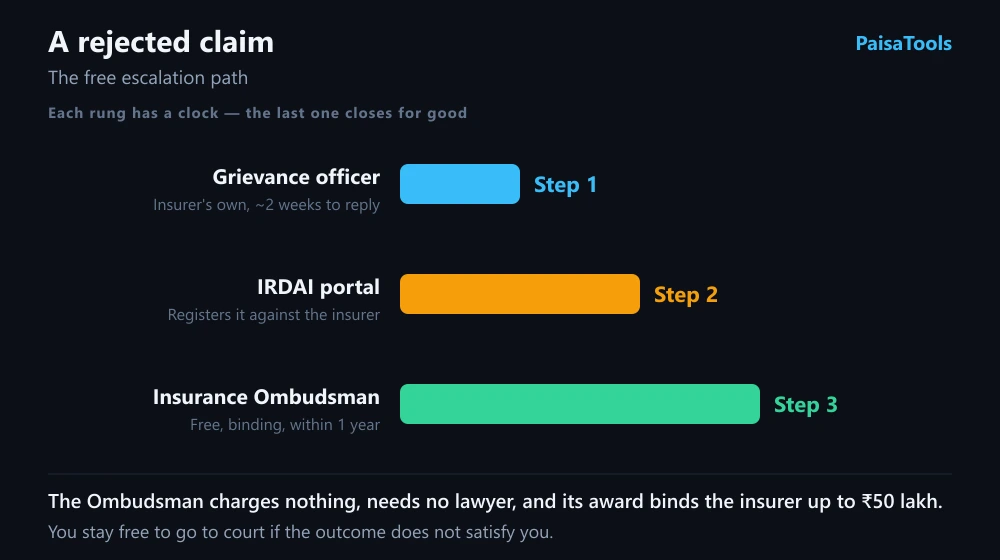
Step 1 — the insurer's grievance cell
Every insurer has a Grievance Redressal Officer, separate from the claims team that said no. Write to them, not to the branch. Quote the claim number, the rejection date, the clause they cited, and why it does not apply — in that order, in one page. Attach the discharge summary, the itemised bill and the rejection letter.
Ask for a written response and keep the acknowledgement. Insurers are expected to resolve a grievance within about two weeks; a silence past that is itself grounds to escalate.
Step 2 — the regulator's complaint portal
If the grievance cell refuses or does not reply, the complaint goes to IRDAI through its Bima Bharosa portal. This does not decide your case — it registers it against the insurer and pushes the company to respond, which on its own resolves a fair number of claims. Keep the token number it gives you.
Step 3 — the Insurance Ombudsman
This is the step almost nobody uses, and it is the one with teeth. The Insurance Ombudsman hears the complaint free of charge, needs no lawyer, and its award is binding on the insurer — the company must comply, while you stay free to go to court if you are not satisfied. It can hear personal-lines disputes up to ₹50 lakh. The catch is the clock: you must approach it within one year of the insurer's final reply, and only after you have raised the grievance with the insurer first.
- Find the Ombudsman office for the city where the insurer's branch is located, or where you live.
- File online or on paper, with a simple statement of facts and the documents from step one.
- There is no fee at any stage, and no requirement to hire anyone.
- Hearings are informal — you can present the case yourself.
What to keep, from day one
- The policy wording — not the brochure. Only the wording decides a dispute.
- Pre-authorisation approvals and any written estimate from the hospital.
- The itemised bill, the discharge summary and all diagnostic reports.
- Every email and the acknowledgement of each complaint, with dates.
One habit prevents most rejections outright: declare every condition when you buy, even the ones that feel irrelevant. Non-disclosure is the single reason insurers rely on most, and it is the hardest to argue away afterwards.
How much health cover a family actually needsWhat your parents' cover really costsFrequently asked questions
- Is there a fee to complain to the Insurance Ombudsman?
- No. The Ombudsman hears complaints free of charge and you do not need a lawyer. You can present the case yourself, and the process is deliberately informal.
- Is the Ombudsman's decision binding on the insurer?
- Yes — an award is binding on the insurance company. You remain free to pursue a court or consumer forum if the outcome does not satisfy you.
- How long do I have to escalate a rejected claim?
- You generally have one year from the insurer's final reply to approach the Insurance Ombudsman, and you must have raised the grievance with the insurer first.
- What is the most common reason health claims are rejected?
- Non-disclosure of an existing condition at the time of buying, followed by waiting periods and policy exclusions. Declaring everything when you buy prevents most disputes.
- My claim was only partly paid — is that a rejection?
- No, and the argument is different. A partial settlement is usually about specific line items such as non-medical consumables or a room-rent limit, which are easier to question one by one.