
LASIK is quoted like a menu. The same clinic can offer four procedures with four prices, and the jump from the cheapest to the most expensive is larger than most people expect when they first ask what it costs.
Then there is the question of who pays. Most people assume a health policy will cover eye surgery. For LASIK, whether it pays anything at all comes down to one number on your prescription.
What it costs, by procedure
These are typical prices for both eyes. City, surgeon and the pre-surgery tests move them within the range.
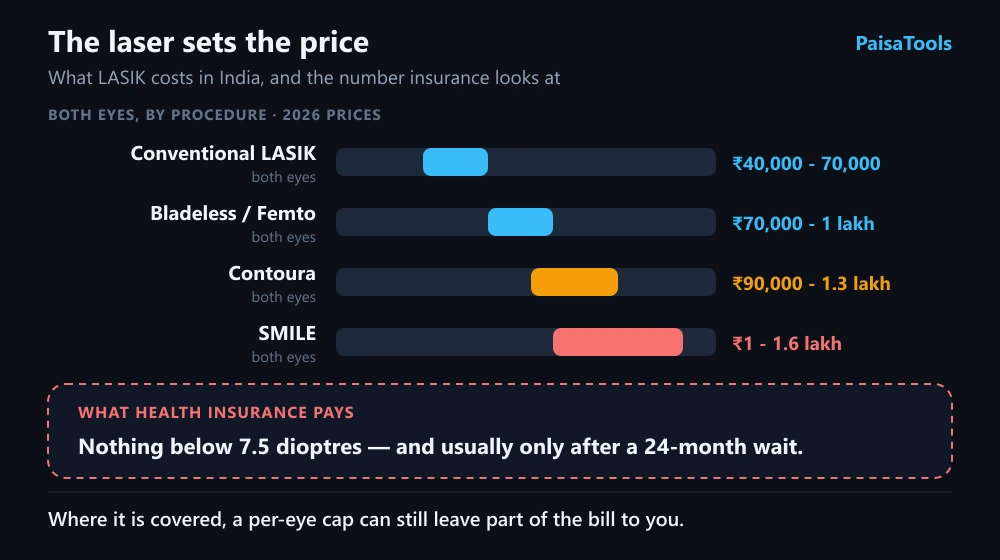
- Conventional LASIK: roughly ₹40,000 to ₹70,000.
- Bladeless, or femto, LASIK — where the flap is cut by a laser instead of a blade: roughly ₹70,000 to ₹1 lakh.
- Contoura — treatment mapped to the shape of your own cornea: roughly ₹90,000 to ₹1.3 lakh.
- SMILE — a small-incision procedure with no flap: roughly ₹1 lakh to ₹1.6 lakh.
What health insurance actually pays
Most Indian health policies use the standard exclusion wording that removes treatment for refractive error below 7.5 dioptres — the power number on your prescription. Below that line, LASIK is treated as a correction of vision rather than a medical necessity, and the policy pays nothing.
- At 7.5 dioptres or more, many policies do cover it, subject to their terms.
- A waiting period of 24 months for refractive surgery is common, so a policy bought now will not pay for surgery next month.
- Many policies cap eye surgery at a fixed amount per eye, and some pay only what standard LASIK would cost even if you choose a costlier procedure.
- A few newer policy variants have lowered the threshold towards 6 to 6.5 dioptres. Read the exclusion clause of your own policy rather than assuming.
What that means for your bill
At −4 dioptres the policy pays nothing, so a Contoura procedure costs the full ₹90,000 to ₹1.3 lakh out of your own pocket. At −8 dioptres the same policy may pay — but if it caps eye surgery at ₹40,000 per eye and the bill is ₹1.3 lakh, it pays ₹80,000 and you pay the remaining ₹50,000. Either way, the cheapest route is to check the exclusion clause, the waiting period and the per-eye cap before booking, not after.
Who can have it
Surgeons generally want patients to be at least 18, with a prescription that has not changed for about a year, and healthy corneas of enough thickness — which is exactly what the pre-surgery tests measure. Those tests are sometimes charged separately; ask whether the quote includes them.
Paying for it
Clinics often offer no-cost EMI on LASIK. That can be a reasonable way to spread a planned cost, but the price quoted with no-cost EMI is not always the price you would get paying in full. Compare both before signing.
What no-cost EMI really costsWork out an EMI on the amountHow hospital bills and room-rent limits workFrequently asked questions
- What is the cost of LASIK surgery in India for both eyes?
- Roughly ₹40,000 to ₹70,000 for conventional LASIK, ₹70,000 to ₹1 lakh for bladeless LASIK, ₹90,000 to ₹1.3 lakh for Contoura and ₹1 lakh to ₹1.6 lakh for SMILE. City, surgeon and pre-surgery tests move the price within these ranges.
- Is LASIK covered by health insurance in India?
- Usually only when the refractive error is 7.5 dioptres or more. The standard exclusion wording removes treatment below that level. Where it is covered, a 24-month waiting period and per-eye caps are common.
- What is the waiting period for LASIK in health insurance?
- Commonly 24 months from the start of the policy for refractive surgery. A policy bought just before surgery will not pay for it.
- Which LASIK procedure is the most expensive?
- SMILE, at roughly ₹1 lakh to ₹1.6 lakh for both eyes, followed by Contoura. Conventional LASIK is the least expensive.
- What is the minimum age for LASIK?
- Generally 18, with a prescription that has stayed the same for about a year and corneas thick and healthy enough for the procedure, which the pre-surgery tests check.