
People search for a loan without documents when they need money in a hurry and expect to be refused. That is exactly the state of mind the worst lenders are built around, so it is worth knowing what the phrase can honestly mean before you tap anything.
What "without documents" can legitimately mean
There are only two honest mechanisms, and both are mundane.
The first is that the lender already has your documents. A pre-approved offer from a bank you already hold an account with is not a loan without paperwork; it is a loan where the paperwork was done when you opened the account, and the KYC is already on file. That is why it can disburse in minutes.
The second is that there is something backing the loan, so your income record matters less. A loan against a fixed deposit, against gold, or against mutual fund units is fast and light on documents because the lender is holding an asset. Those routes exist and are cheap relative to anything unsecured.
What does not exist is an unsecured loan to a stranger, with no records and no credit history, at a sane price. If a lender has no way to assess you and no asset to hold, the only way the business works is by charging enormously or by collecting in ways it should not. There is no third option, and recognising that is most of the protection.
The four checks
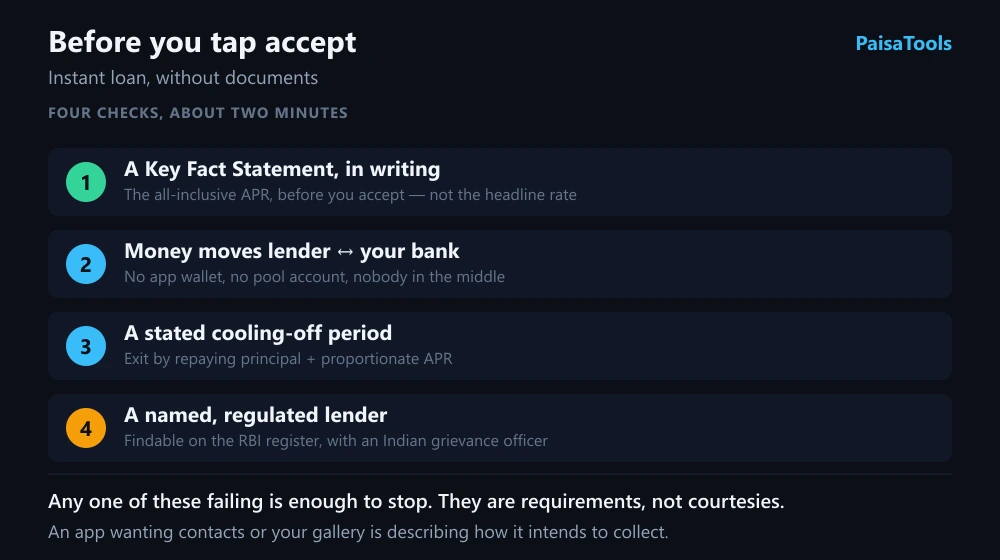
Digital lending in India is regulated, and the rules give you four tests you can run yourself in a couple of minutes. These are not matters of taste — a lender that fails any of them is not operating the way a regulated lender is required to.
1. A Key Fact Statement, with the all-inclusive rate, before you agree
You are entitled to a Key Fact Statement before the loan contract is executed. It must set out the annual percentage rate on an all-inclusive basis — the cost with the fees folded in, not the headline interest with charges mentioned elsewhere — along with the amount, the tenure, the repayment schedule, the processing fee, penal charges and any prepayment cost.
This is the fastest single test there is. An app that will not show an all-inclusive APR in writing before you accept is not merely unhelpful; it is failing a disclosure requirement, and hiding the true cost is precisely what the requirement exists to prevent. If you take one thing from this page, take that: no written APR, no loan.
2. The money moves between the lender and you, and nobody else
Disbursal and repayment are supposed to flow directly between the regulated lender and your own bank account. No pass-through pool account, no wallet belonging to the app, no third party in the middle. This is a useful check because it is visible: look at where the credit came from, and where the repayment is being collected to. Money arriving from, or demanded to, an account that is not the named lender's is a serious sign.
3. A cooling-off period you can actually use
There must be a cooling-off window in which you can exit the loan by repaying the principal and the proportionate annual percentage rate, without a penalty beyond a disclosed one-time processing fee. The minimum is short — a day — and the lender's board may set longer. The point is that it exists and is stated. A loan you cannot back out of on the day you took it is not being offered on the terms the rules require.
4. A named regulated lender, and a grievance officer in India
The app is often not the lender. It is frequently a service provider working for a bank or an NBFC, which is permitted — but the actual regulated lender must be named to you, and you should be able to find that name on the Reserve Bank's own register of regulated entities rather than only on the app's website. There must also be a grievance-redressal channel staffed in India, and borrower data is required to be stored in India. If the app cannot tell you which regulated entity is lending, you do not know who you are borrowing from.
What "approved despite low CIBIL" is really pricing
A poor credit record does not make a lender generous; it makes you expensive to lend to, and that has to show up somewhere. Sometimes it shows up honestly, as a high but disclosed rate. Sometimes it shows up as a processing fee deducted up front, so you receive materially less than the sanctioned amount while repaying on the full figure — which is why the all-inclusive APR matters more than the interest rate. And sometimes it shows up at collection time instead of at pricing time, which is the case to avoid entirely.
The permissions an app asks for tell you which of those you are dealing with. A lender assessing your ability to repay needs identity, income and bank information. It does not need your contacts, your gallery or your call log. Those are not underwriting data; they are collection data, and an app asking for them is telling you how it intends to be repaid.
If you have already borrowed from one
Keep every record — the sanction, the statement, what was actually credited, what has been demanded — because the gap between the sanctioned amount and the credited amount is often the clearest evidence that something was wrong. Repayment pressure that involves your contacts, your employer or threats is not a grey area, and the conduct rules on recovery apply regardless of how the loan was sold to you.
What recovery agents are and aren't allowed to doFrequently asked questions
- Are instant loan apps that need no documents safe?
- Mostly not. A genuinely document-light loan is either a pre-approved offer from a lender who already holds your KYC, or a loan secured against an asset such as a fixed deposit or gold. An unsecured loan to someone with no records and no credit history cannot be priced sanely, so apps offering it tend to make the economics work through very high charges or through collection practices that are not permitted.
- What is a Key Fact Statement and why does it matter?
- It is the disclosure a lender must give you before the loan contract is executed, setting out the all-inclusive annual percentage rate along with the amount, tenure, repayment schedule, processing fee and penal charges. It matters because it converts a scattered set of charges into one comparable number. A lender unwilling to put that number in writing before you accept is failing a requirement, not just being awkward.
- How do I check whether a loan app's lender is regulated?
- Ask the app which regulated entity is actually lending — the app is often only a service provider — and then look for that entity on the Reserve Bank of India's own register of banks and NBFCs rather than relying on the app's claims. Also check that there is a grievance-redressal contact based in India. If no regulated lender is named, you cannot establish who holds the loan.
- Why does a loan app want access to my contacts?
- Because contacts are not used to decide whether you can repay; they are used to pressure you if you do not. Underwriting needs identity, income and banking data. A request for your contact list, gallery or call log is a statement about how the lender intends to collect, and it is the single clearest warning sign in the permission screen.
- Can I cancel a digital loan right after taking it?
- There is meant to be a cooling-off period during which you can exit by repaying the principal plus the proportionate annual percentage rate, with no penalty other than a disclosed one-time processing fee. The minimum window is a day and the lender may offer longer. Whether such a window is clearly stated is itself a test of whether the lender is operating properly.