
The case for an MBBS abroad is presented as simple arithmetic, and on the face of it the arithmetic is real. A private medical seat in India runs into tens of lakhs and often past a crore. A full six-year degree in Russia or Georgia can be had for less than the first two years of that.
What the brochure leaves out is that the degree is not a licence. It is permission to sit an exam — and the pass rate on that exam is the number the entire decision actually turns on.
What the course costs, end to end
These are whole-course figures including tuition, hostel and living, not tuition alone, which is how the low numbers in advertisements are usually produced.
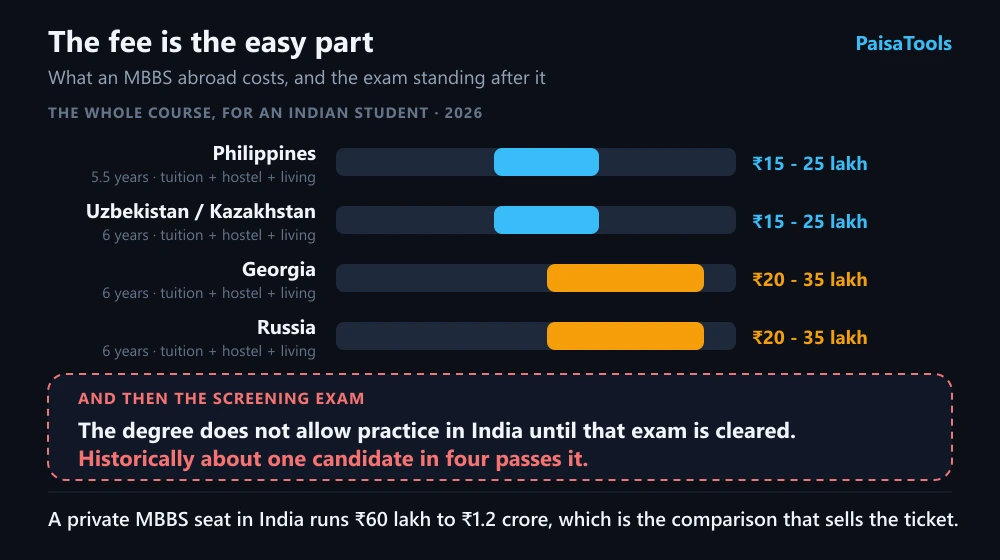
- The Philippines: roughly ₹15 lakh to ₹25 lakh across a 5.5-year programme, which follows an American-style structure with a pre-medical year.
- Uzbekistan and Kazakhstan: roughly ₹15 lakh to ₹25 lakh across six years, currently the cheapest of the common destinations.
- Georgia: roughly ₹20 lakh to ₹35 lakh across six years.
- Russia: roughly ₹20 lakh to ₹35 lakh across six years, with the widest spread between universities of any destination on this list.
Add flights home, visa renewals, insurance and the coaching almost every student ends up buying for the Indian screening exam. None of that appears in a consultant's quotation.
The conditions that decide whether any of it counts
The National Medical Commission sets out what a foreign medical degree must look like before an Indian graduate can even apply to register. Miss one and the degree cannot be registered in India at all — not after an exam, not after an appeal.
- You must have qualified in NEET-UG before starting. A student who left without it has no route back.
- The course must run at least 54 months.
- It must be taught entirely in English — which is a different claim from being advertised in English.
- It must include a 12-month internship, taken at the same institution that taught the course.
- You must be registered to practise with the professional regulator of that country.
The exam is the decision, not the fee
A foreign medical graduate cannot practise in India until they clear the screening examination. Historically only around a quarter of candidates pass it, and that rate has been stubborn across years and destinations. It is not a formality, and it is not something a good student can assume away.
Run it as a cohort rather than as a hope. If four families each spend ₹25 lakh and one of the four children ends up licensed in India, that cohort has spent ₹1 crore per practising doctor — which lands in the same territory as the private Indian seat the route was meant to avoid, and that is before counting repeat attempts and the years they consume. The figure says nothing about any individual student; it says the saving is real only if you are confident of being in the quarter that passes, and it is worth asking honestly what that confidence rests on.
What actually moves the odds
The university matters more than the country. Pass rates vary enormously between institutions within the same destination — the long-established medical universities with real clinical volume produce very different outcomes from the ones that appeared recently to serve Indian demand.
So the question to put to a consultant is not what a country's fees are. It is what that specific university's Indian graduates have done in the screening exam over the last three years, and how many Indian students it enrols against how many teaching hospital beds it has. A consultant who cannot answer that is selling a seat, not advising on a career.
Language is the other quiet one. Teaching may be in English while the ward round, the patient and the notes are not. Clinical years spent unable to speak to patients are the most common explanation students themselves give for struggling with the exam afterwards.
The years nobody puts in the budget
Six years of course, a year of internship, then the exam — and each unsuccessful attempt is another year without income, usually with coaching fees attached. A student who clears on the third attempt has spent close to a decade between school and a first salary. That decade is a real cost even when no one invoices for it.
Funding it, and the debt that outlives the decision
Education loans for foreign medical degrees are commonly given against property, and they begin repayment after a fixed grace period whether or not the screening exam has been cleared. That is the sharpest edge in this whole decision: the EMI does not wait for the licence.
Before committing, put the actual EMI next to a realistic income for the years immediately after return — which, if the exam is not cleared first time, may be no medical income at all.
Work out the EMI on the education loan before you commitThe comparison people should actually be making
It is not abroad versus a private Indian seat. It is abroad versus a government seat taken a year later after another NEET attempt, versus a private seat, versus a different career entirely. A year of preparation is cheap next to six years and a one-in-four exam.
What an MBBS in India costs, government seat and privateFrequently asked questions
- How much does MBBS abroad cost for an Indian student?
- Including tuition, hostel and living for the whole course, roughly ₹15 lakh to ₹25 lakh in the Philippines, Uzbekistan and Kazakhstan, and roughly ₹20 lakh to ₹35 lakh in Georgia and Russia. Flights, visa renewals, insurance and screening-exam coaching sit on top and are usually left out of quotations.
- Is NEET required for MBBS abroad?
- Yes. Qualifying in NEET-UG before starting the course is a condition for registering the degree in India afterwards. A student who goes abroad without it cannot register on return, whatever the degree or the exam result.
- What percentage of foreign medical graduates pass the Indian screening exam?
- Historically about one in four, and the rate has been consistent enough across years and destinations to plan against rather than hope past. It varies sharply by university, which is why the individual institution's record matters more than the country's fee.
- What are the NMC rules for studying MBBS abroad?
- The course must be at least 54 months, taught entirely in English, and include a 12-month internship at the same institution, and the graduate must be registered to practise with that country's own regulator. NEET-UG qualification before starting is also required. Failing any one of these makes the degree unregistrable in India.
- Is MBBS abroad cheaper than a private college in India?
- On the sticker price, clearly yes — a full course abroad can cost less than the first two years of a private Indian seat. Whether it is cheaper in practice depends on clearing the screening exam, because a degree that cannot be registered has no Indian value at all.