
Both pay a fixed rate, both are offered by the same banks, and both are quoted at the same number on the same rate card. People read that and assume the two are interchangeable. They are not, and the reason has nothing to do with the rate.
An FD takes one lump sum on day one. A recurring deposit takes a fixed amount every month. The money therefore spends very different amounts of time earning.
Why an FD earns more on the same money
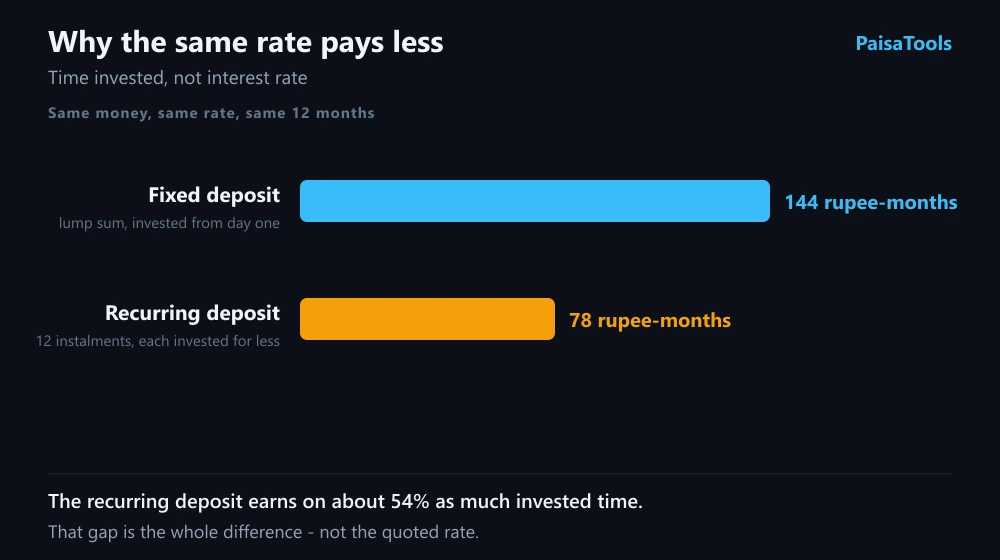
Put ₹1.2 lakh into an FD for a year and the whole ₹1.2 lakh earns for twelve months. Put ₹10,000 a month into an RD for a year and only the first instalment earns for twelve months. The second earns for eleven, the third for ten, and the final instalment earns for one. The average rupee sits for roughly half the term.
At the same quoted rate and the same total amount, an RD returns roughly half the interest an FD does over the same period — because the average instalment has been invested for about half the term. A 7% RD is not a worse 7%; it is 7% applied to money that has been there for less time. The comparison only becomes fair when you ask what else the monthly amount would have done in the months it had not yet been deposited, which for most people is sitting in a savings account at 3%.
So when does each one win
- You already have the money: FD. There is no argument for drip-feeding a sum you are holding in a savings account at a lower rate.
- You do not have it yet: RD. It converts a monthly surplus into a disciplined deposit, and the alternative is not an FD — it is the money being spent.
- You want a specific date: both work, but an RD lines up naturally with a salary cycle.
- You want flexibility: neither is ideal. Breaking either early costs a rate penalty.
The tax treatment is the same, and it catches people out
Interest on both is fully taxable at your slab, added to income for the year it accrues — not the year you withdraw. Banks deduct TDS once interest crosses the threshold for the year, and the form you can file to stop that deduction only applies if your total income is genuinely below the taxable limit. Filing it otherwise is a declaration you cannot back up.
This is why a 7.1% tax-free instrument can beat an 8% deposit for someone in the top slab, and why comparing headline rates across categories is the most common mistake in this whole area.
What actually decides it
Ask one question: does the money exist today? If it does, the RD has no advantage and a real disadvantage. If it does not, the RD is not competing with an FD at all — it is competing with spending the money, and against that it wins easily.
Compare what each one pays on your numbersDoubling money at the post office: KVP explained (Hindi)Frequently asked questions
- Is the RD rate lower than the FD rate?
- Usually they are similar for the same tenure, and some banks quote them identically. The gap in what you actually receive comes from how long each rupee has been invested, not from the quoted rate.
- Can I break an RD early?
- Yes, with a penalty — typically the rate is reduced to what applied for the period actually completed, minus a margin. The same applies to an FD, so neither should hold money you may need at short notice.
- Does missing an RD instalment matter?
- Banks charge a small penalty for a missed month, and repeated misses can let the bank close the deposit early. It is worth setting the instalment at an amount you are certain of rather than an ambitious one.
- Which is better for a short goal a year away?
- If you hold the money now, an FD. If you are accumulating it over those twelve months, an RD. The honest answer depends entirely on whether the sum already exists.
- Do senior citizens get more?
- Most banks add a margin over the standard rate for senior citizens on both products, and that margin applies to the tenure you pick. It does not change the structural difference described above.