
PaisaTools Research · Household money
Has Central Government Pay Kept Pace With Prices Since January 2016?
Dearness allowance is meant to protect government pay from rising prices. We tracked a pay cell of the 7th Pay Commission matrix, month by month, against the official price index for industrial workers, from January 2016 to September 2026.
Published 22 November 2026 · Data to September 2026 (latest CPI-IW month on labourbureau.gov.in, read 22 November 2026) · How we did it · Download the data (CSV) · Brief
Key findings
- In September 2026 a central government pay cell's basic pay plus DA, at the rate due, bought 2.1% less than in January 2016, by our calculation from Labour Bureau CPI-IW and Finance Ministry DA orders.Derived At the 60% rate actually paid that month (the 63% order came on 29 October 2026), it bought 3.9% less.Derived Counted from the 2015 average price level instead of January 2016: 5.0% less at the rate due.Derived Limits
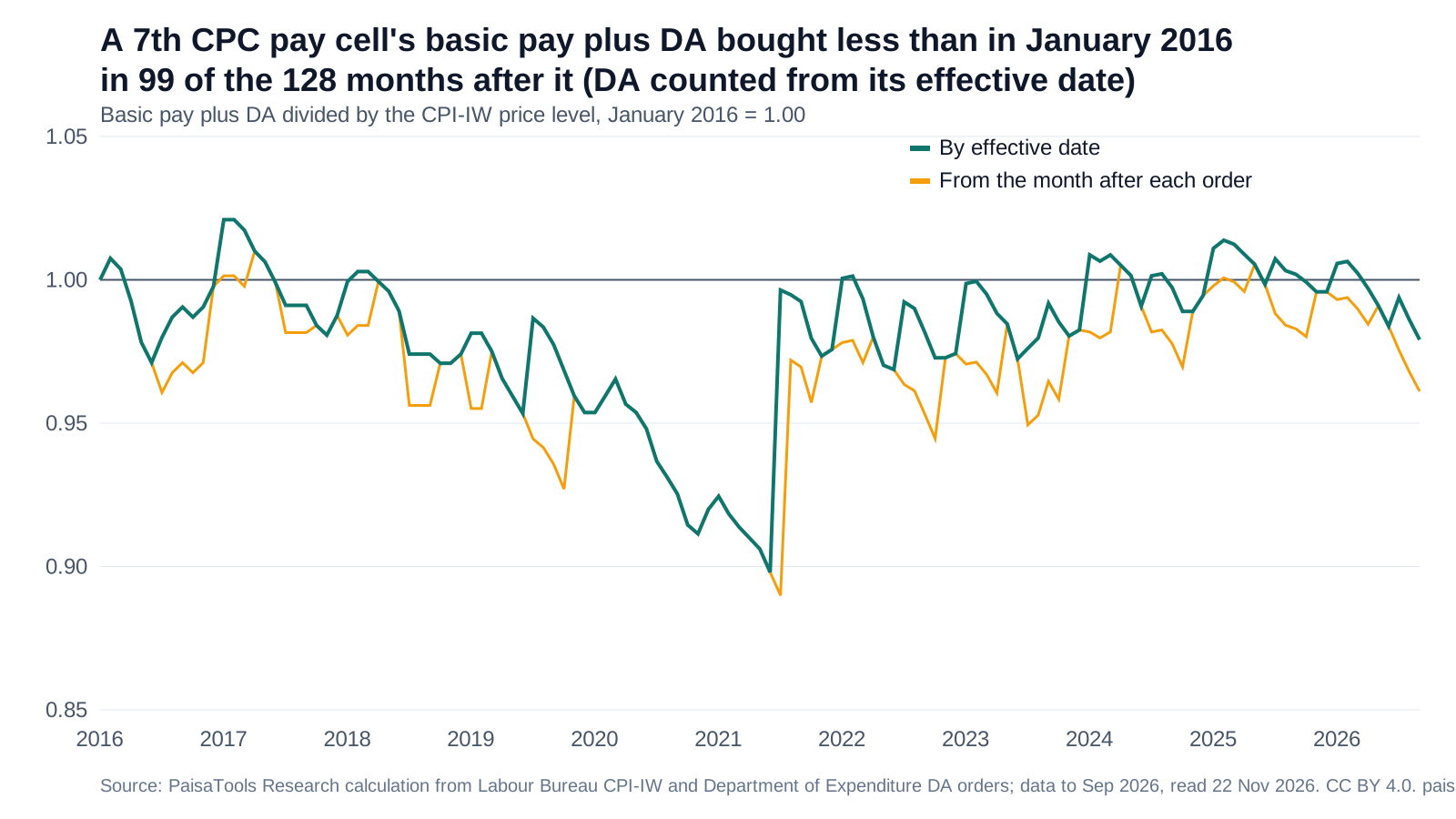
- In 99 of the 128 months after January 2016, up to September 2026, a pay cell's basic pay plus DA bought less than in January 2016, counting each DA rate from its effective date (90 to 107 within the rounding of the published index and its linking factor). Counting each new rate only from the month after its order: 118 (114 if it reaches pay in the order month itself).Derived
- Counting by effective date, the lowest month was June 2021, 10.2% below January 2016: the last of the 18 months (January 2020 to June 2021) in which DA stayed at 17% under the Finance Ministry order of 23 April 2020, by our calculation from CPI-IW.DerivedOfficial
- The Finance Ministry's order for the July 2026 DA rise (OM of 29 October 2026) came 120 days after its 1 July effective date. That is the longest of the 17 rounds from January 2017 to July 2026 that fell outside the 2020-21 freeze, by our count from the orders; the first 7th CPC order, for July 2016, took 126 days.Derived
- For the Level 6 entry pay cell (basic Rs 35,400), matching its January 2016 purchasing power in September 2026 needed Rs 58,935 a month in basic pay plus DA. At the 63% rate due it was Rs 57,702, Rs 1,233 a month below that mark (Rs 2,295 below at the 60% paid that month).Derived
The question and why it matters
The 7th Central Pay Commission's pay matrix took effect on 1 January 2016 with dearness allowance (DA) at zero. Since then the Centre has revised DA twice a year, except during the 2020-21 freeze. On 28 October 2026 the Cabinet approved a rise of 3 percentage points over 60% from 1 July 2026 “to compensate against price rise” (PIB, 28 October 2026); the Department of Expenditure's office memorandum (OM) of 29 October 2026 set the rate at 63% of basic pay.

This study asks whether that compensation has kept up with prices, month by month, using the price index the government itself names for the purpose: the Consumer Price Index for Industrial Workers (CPI-IW), which the Labour Ministry describes as “primarily used to regulate the dearness allowance of government employees ...” (PIB, 22 October 2020). It adds two things that are not published in one place: a monthly real-value series for a 7th CPC pay cell since January 2016, and the number of days between each DA effective date and its order. It does not measure a person's career pay, which also rises with annual increments.
Who is affected
About 48.54 lakh central government employees and 68.71 lakh pensioners, according to the Cabinet release of 28 October 2026.Official The study measures employees' basic pay plus DA. Pensioners' dearness relief follows the same rates but is not modelled here.
What the evidence shows
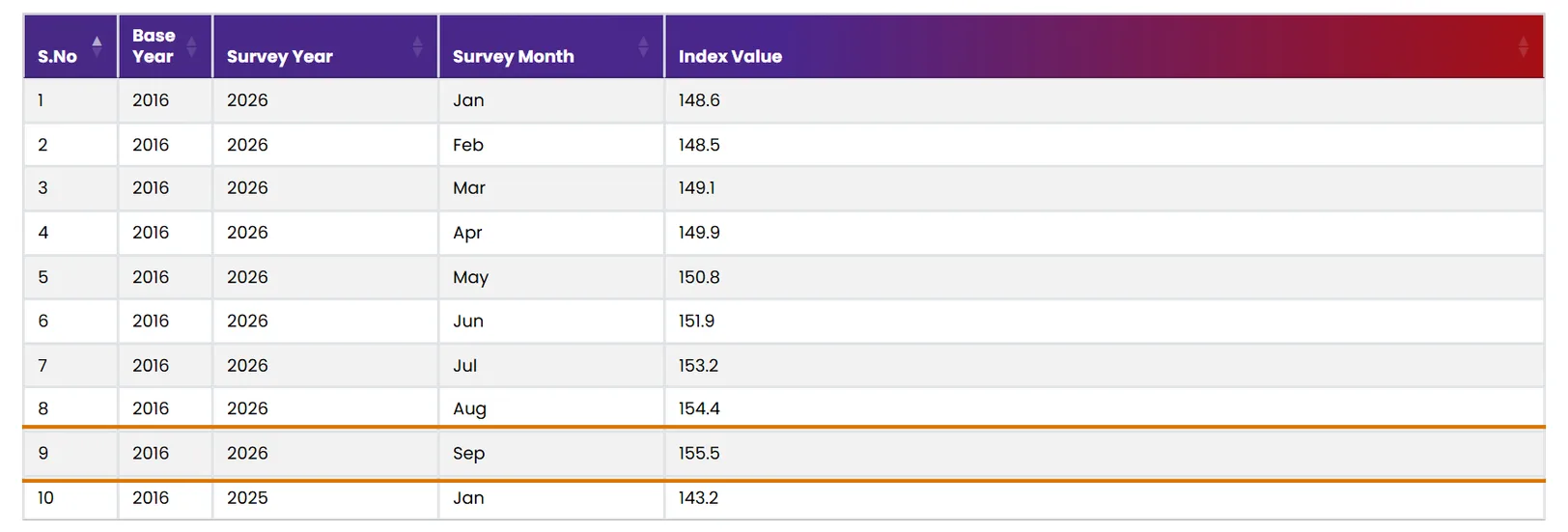
- Prices: CPI-IW stood at 93.40 in January 2016 (published as 269 on base 2001=100, linked to the 2016 series with the official factor 2.88) and 155.5 in September 2026 (published, base 2016=100), a rise of 66.5%.Derived
- DA went from 0% to 63% of basic pay over the same period (OMs of 4 November 2016 and 29 October 2026).Official
- So a pay cell's basic pay plus DA bought 1.63 / 1.6648 = 0.979 of its January 2016 amount in September 2026 at the 63% rate due (0.961 at the 60% paid).Derived
Why January 2016: it is the month the 7th CPC pay matrix took effect, with DA at zero. Counted instead from the 2015 average CPI-IW (261 on base 2001), the September 2026 value is 0.950, 5.0% below.Derived
Every DA rate since January 2016
23 rows from 20 Finance Ministry OMs. Days: from the effective date to the date of the OM.
Rates and OM numbers: Official. Days: Derived.
The scale
Formula in words: purchasing power in a month = (1 + DA rate in force) divided by (CPI-IW that month / CPI-IW January 2016). 1.00 means the cell buys what it bought in January 2016. Because DA is a percentage of basic pay, this ratio is the same for every cell of the pay matrix; only the rupee amounts below differ by level.
The mean over the 129 months: 0.982 counting each rate from its effective date, 0.970 counting from the month after its order.Derived
What the documents show about the causes
- The freeze. Under the Finance Ministry order of 23 April 2020, the instalments due from 1 January 2020, 1 July 2020 and 1 January 2021 were not paid; the restoration OM of 20 July 2021 records that DA for 1 January 2020 to 30 June 2021 stayed at 17% and that the 28% rate from 1 July 2021 subsumes those instalments (as recorded in our DA history from the OMs). The series falls from 0.954 (December 2019) to 0.898 (June 2021).Derived
- The order gap. DA applies from 1 January and 1 July, but the orders come later: 57 to 120 days for the 17 rounds from 2017 to 2026 outside the freeze. The difference for those months is paid later as arrears, in rupees at the new rate; until the order, monthly pay stays at the old rate.Derived
The orders do not say why each order took the time it did. Our reading: a rate that follows a price average, applied in six-month steps, will trail a rising index between revisions; the series shows this pattern but the documents do not state it.
Money effect: three pay cells
Level 6 entry pay cell, basic Rs 35,400 (7th CPC pay matrix; a pay cell, not a person's pay, which also rises with increments). In September 2026, matching January 2016 purchasing power needed Rs 58,935 in basic plus DA; at the 63% rate due it was Rs 57,702 (Rs 1,233 below that mark); at the 60% paid in September, Rs 56,640 (Rs 2,295 below). Level 1 entry cell (Rs 18,000): Rs 627 below at 63%, Rs 1,167 at 60%. Level 10 entry cell (Rs 56,100): Rs 1,954 below at 63%, Rs 3,637 at 60%.Derived
Comparisons
July rounds, days from 1 July to the Centre's order: 2016 126 (first 7th CPC instalment, ordered on 4 November 2016), 2017 81, 2018 68, 2019 105, 2021 116 (31% order), 2022 94, 2023 111, 2024 112, 2025 97, 2026 120. January rounds: 2017 88, 2018 73, 2019 57, 2022 89, 2023 92, 2024 71, 2025 91, 2026 111.Derived
What could be done
Options named in official documents: none on timing in the orders read. One option, ours and not in any document read: publish the DA order within a fixed number of days of the CPI-IW release that completes the half-year.
Limits
- One pay cell, no annual increments (about 3% a year), no HRA or transport allowance: this measures the scale, not a person.
- The base month matters. Measured against the 2015 annual average CPI-IW (261 on base 2001) instead of January 2016, the September 2026 value is 0.950 (5.0% below). The 7th CPC report defines DA as “that percentage of pay by which the CPI (IW) increases over a fixed base value” (para 4.2.10, page 63) and recommends “continuance of the existing formula” (para 8.17.37, page 342); it does not state the base value, so we do not use one.DerivedOfficial
- The base-2001 index is published in whole numbers and the linking factor (2.88) to two decimals. Both roundings carry into January 2016, the base of every ratio. At the edges of that rounding (January 2016 = 268.5 to 269.5; factor 2.875 to 2.885), the September 2026 figure at the rate due lies between 1.7% and 2.4% below January 2016, and the count of months below lies between 90 and 107. We report the values from the official figures as published.Derived
- The linked series is joined at September 2020; on it the 2016 average is about 95, not 100, because the old and new baskets moved differently between 2016 and 2020.Derived
- CPI-IW measures prices for industrial workers' households; other households face a different basket.
- The “paid” view counts a new rate from the month after its order and leaves out the arrears that are paid later. It shows when the higher rate reached monthly pay, not a loss of money. If a new rate reached pay in the order month itself, the months below January 2016 in this view would be 114, not 118; actual payroll months vary by office.
Method and sources
- Labour Bureau, Annual Report on CPI-IW 2019, Table 4.1 (monthly, base 2001) (PDF) and Annual Report 2020, month-wise table and linking-factor table (PDF); All-India index (base 2016, September 2020 onward), read 22 November 2026. Units: index points.
- Months from January 2016 to August 2020 are the published base-2001 values divided by the official linking factor 2.88 (PIB, 22 October 2020); September 2020 onward as published on base 2016.
- PIB, Ministry of Labour and Employment, 22 October 2020, PRID 1666782 (new series, linking factor 2.88, use for DA).
- Department of Expenditure DA OMs, 4 November 2016 to 29 October 2026 (23 rows from 20 OMs; numbers, dates and links in the table above and in the CSV). Units: % of basic pay.
- PIB, Ministry of Finance, Cabinet decision, 28 October 2026, PRID 2329485 (headcount, purpose, formula reference).
- Report of the Seventh Central Pay Commission, paras 4.2.10 and 8.17.37 (DA definition and formula), read 22 November 2026.
- 7th CPC pay matrix (CCS (Revised Pay) Rules, 2016), entry cells of Levels 1, 6 and 10. Units: Rs a month.
- Every figure was recomputed independently from the primary files by an AI agent on 22 November 2026, and the draft was reviewed by an AI editorial gate; no human reviewer. House rules: methodology and editorial standards.
Data and tools
central-pay-vs-cpi-iw-2016-2026.csv (one row per month, with the published index, its base, its source and link, the DA rate and OM in each view) and its data dictionary; da-history-central.csv (the orders). Related tools: Sarkari pay calculator, DA arrear calculator, Wealth reality check.
Changelog
- 22 November 2026: first published.
- 22 November 2026, later: added screenshots of the Labour Bureau CPI-IW table and the PIB release of 28 October 2026. No figure changed.
Cite this research
Source: PaisaTools Research, "Has Central Government Pay Kept Pace With Prices Since January 2016?", 22 November 2026. https://paisatools.co.in/research/central-pay-vs-prices-2016-2026
Licence: our text, charts and calculated data are CC BY 4.0. You may reuse them with credit; no permission needed. CPI-IW values (Labour Bureau) and DA orders (Department of Expenditure) keep their own terms; we link them. Document screenshots are credited under each image and are not covered by our licence. Corrections within 2 working days of a valid report: contact. Facts from the documents; not legal or financial advice.
Brief
- In September 2026 a central government pay cell's basic pay plus DA, at the rate due, bought 2.1% less than in January 2016 (3.9% less at the rate actually paid), by our calculation from Labour Bureau CPI-IW and Finance Ministry DA orders.
- Why now: the Centre's order raising DA to 63% from 1 July 2026 came on 29 October 2026, 120 days after it took effect, the longest of the 17 rounds since January 2017 outside the 2020-21 freeze.
- How we know: 129 months of CPI-IW (Labour Bureau) and 20 DA office memorandums (Department of Expenditure, 2016-2026); method.
- Data: CSV (our calculations CC BY 4.0); chart.
- Contact: contact; corrections within 2 working days.