
An American degree is priced in two places. The first is the tuition figure on the university's page, which every family reads. The second is a form called the I-20, which asks you to prove you already have a year of that money — in a form the university will accept — before the visa interview is even scheduled.
Most plans fail at the second one, not the first. The figures below use the US dollar at ₹95.96, the rate on 15 September 2026.
Tuition, by where you get in
- A master's at a public state university: roughly USD 12,000 to USD 45,000 a year, with the wide spread driven by the state and whether the programme is in engineering, computing or business.
- A master's at a private university: roughly USD 50,000 to USD 75,000 a year.
- Living costs on top: roughly USD 12,000 to USD 20,000 a year, and where the university sits matters more than the university does. A programme in a small college town and the same programme in the Bay Area are different financial decisions.
- Across a two-year master's, tuition and living together commonly total USD 45,000 to USD 120,000 — at today's rate, about ₹43 lakh to ₹1.15 crore.
The visa, which has become a real line
Student visa costs used to be a rounding error on a fifty-lakh decision. They are no longer trivial, and the increase is recent enough that most advice online still quotes the old total.
- SEVIS I-901 fee: USD 350, paid before the interview.
- MRV visa application fee: USD 185.
- Visa Integrity Fee: USD 250, the addition that pushed the total up by roughly 47 per cent.
- Together that is around USD 785 — close to ₹75,000 — before the English test, the courier and the photographs.
None of it is refundable if the visa is refused, which is worth knowing before treating the application as a cheap option to keep open.
The rule that decides most applications
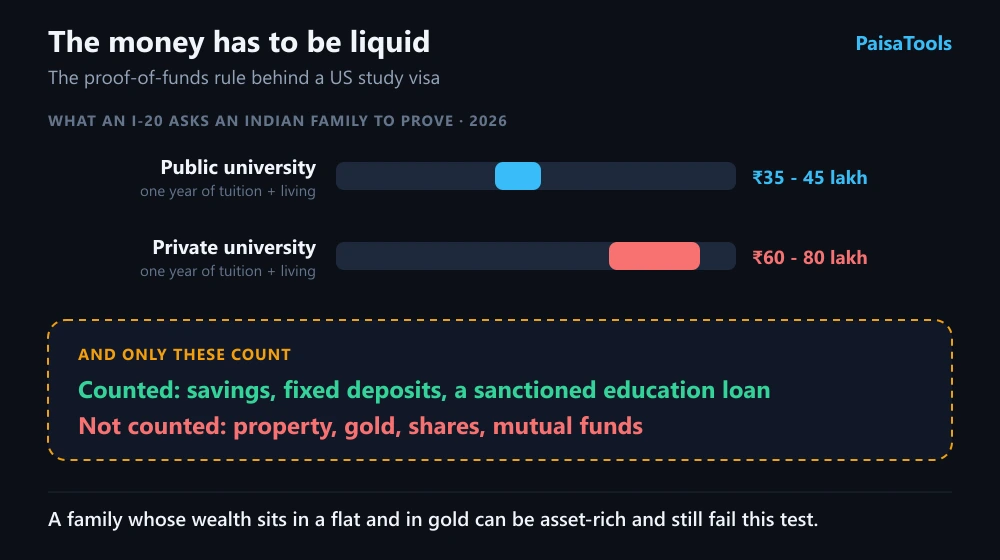
To issue the I-20, a university needs proof that the first year is funded. For a public university that is commonly ₹35 lakh to ₹45 lakh; for a private one, ₹60 lakh to ₹80 lakh.
The size of the number is not usually the problem. The form the money has to be in is. Savings balances, fixed deposits and a sanctioned education loan from a recognised lender are accepted. Property, gold, shares and mutual funds are not, because the test is whether the money can be converted immediately, not whether the family is wealthy.
That rule lands hard in India specifically, because Indian household wealth is concentrated in exactly the two assets it excludes — the house and the gold. A family with two crore of net worth and eight lakh in the bank can be turned down where a family with far less, held in a fixed deposit and a sanctioned loan, sails through.
The practical consequence is a timing one. Moving money into an acceptable form takes weeks — selling, transferring, letting it season in an account, getting the loan sanctioned in writing. Families who discover the rule after the admission letter arrives are the ones who lose an intake.
What the whole thing comes to
A two-year master's at a mid-range public university, at USD 30,000 of tuition and USD 16,000 of living a year, is about USD 92,000 — roughly ₹88 lakh at ₹95.96 to the dollar — before flights, the visa stack and setup costs push it past ₹90 lakh. The same programme at a private university, at USD 60,000 of tuition, runs closer to ₹1.45 crore. And the rupee figure moves with the rate on the day each instalment is paid, not the rate on the day the offer arrived.
The exchange rate is a cost line of its own
Nobody budgets for it, and over a two-year programme it is as large as a semester of tuition. The rupee has gone from about ₹85 to the dollar to ₹95.96, which raises the rupee cost of an identical dollar budget by roughly 13 per cent. Nothing about the course changed, and nobody was told.
The defence is not prediction. It is to fix the rupee amount the family can actually afford, decide the programme against that, and accept that a weaker rupee has to be absorbed by choices already made rather than by hoping the rate comes back.
Working while studying, honestly
An F-1 student may work on campus up to 20 hours a week during term. Off-campus work generally requires authorisation tied to the field of study, and it is not available from day one.
On-campus wages can cover a meaningful part of living costs once a job is found, and campus jobs are competitive. Two things do not change: the I-20 requires the full first-year funding proved without counting that income, and a budget that only works if the job appears in the first semester is not a budget.
Sending the fees, and the tax on doing it
Education remittances above ₹10 lakh in a financial year attract tax collected at source when they are self-funded, and none when they are funded by an education loan from a qualifying Indian lender. TCS is claimable back against your own tax, so it is a cash-flow cost rather than a loss — but on a fee instalment it is cash that is unavailable exactly when the university wants paying.
How TCS on studying abroad works, and how to keep it at zeroThe quieter cost is the forex markup. Banks commonly build 2 to 3.5 per cent into the exchange rate on an international transfer, taken quietly on every instalment across the programme. On a bill this size that markup alone outweighs the visa, the flights and the English test combined. Compare the rate you are quoted against the mid-market rate before every single transfer.
The loan, and the number that actually matters
Most families fund this with savings plus an education loan, and the loan does two useful things beyond the money: it removes TCS on the remittance, and the interest qualifies for deduction under Section 80E — section 129 of the Income-tax Act, 2025 — for up to eight years, in the old regime.
What it does not change is the EMI the student starts paying after the grace period. That is the number to test before accepting the admission, against a realistic starting salary rather than a median one from a placement report, and against the possibility of returning to India to repay a dollar-denominated cost out of rupee income.
Work out the EMI on the education loan firstCheck whether studying abroad is affordable for youHow it compares
The USA is the most expensive of the common destinations for an Indian student, and its case rests on earning power after graduation rather than on cost. Germany charges little or no tuition at public universities and Canada sits between the two. The right comparison is not the fee but the total outlay against the realistic post-study earning in each, including the odds of being allowed to stay and work.
What studying in Canada costs, in rupeesWhat studying in Germany costs, in rupeesFrequently asked questions
- What is the total cost of an MS in the USA for an Indian student?
- Across two years, tuition and living together commonly total USD 45,000 to USD 120,000, which is about ₹43 lakh to ₹1.15 crore at ₹95.96 to the dollar. A mid-range public university lands near the lower half of that; a private university near the top.
- How much bank balance is needed for a US student visa?
- Enough to cover the first year of tuition and living, which is commonly ₹35 lakh to ₹45 lakh for a public university and ₹60 lakh to ₹80 lakh for a private one. The amount must be shown in liquid form before the I-20 is issued.
- Does property or gold count as proof of funds for an I-20?
- No. Only assets that can be converted to cash immediately are accepted — savings balances, fixed deposits and a sanctioned education loan. Property, gold, shares and mutual funds are excluded, which is why Indian families are often asset-rich and still short on the paperwork.
- How much does a US student visa cost in 2026?
- The SEVIS I-901 fee is USD 350, the MRV application fee is USD 185, and the Visa Integrity Fee is USD 250 — around USD 785 in total, close to ₹75,000. The Integrity Fee pushed the total up by roughly 47 per cent, and none of it is refunded if the visa is refused.
- Can a student cover US living costs by working?
- Partly. An F-1 student can work up to 20 hours a week on campus during term, which can cover a meaningful share of living costs once a job is found. It cannot be counted towards the I-20 funding proof, and off-campus work generally needs separate authorisation tied to the field of study.