
The Jio Platforms IPO is the one almost every retail investor in India is waiting for, and the most searched question about it is not the price. It is whether owning Reliance Industries shares gets you a better shot at an allotment, and what date you need to own them by. The answer sits in the draft offer document Jio filed with SEBI on 19 June 2026, and it is slightly different from what most forwards say.
What the shareholder quota actually is
Reliance Industries is Jio Platforms' promoter, holding 66.43% of the company before the issue. Like other listed parents before it, Reliance has set aside a separate portion of the IPO, the 'RIL Shareholders Reservation Portion', that only eligible Reliance shareholders can bid in. Its size is still blank in the draft document; it will be filled in when the final offer document, the red herring prospectus (RHP), is filed.
The issue itself is a fresh issue of up to 27 crore shares of face value ₹10, with no shares being sold by existing investors. There is also a separate quota for eligible employees.
Source: Jio Platforms draft red herring prospectus, SEBI (19 June 2026)
Who counts as an eligible Reliance shareholder
- Individuals and HUFs only. Companies, trusts and institutions holding Reliance shares do not qualify for this quota.
- You must be a public equity shareholder of Reliance Industries in your own name. Owning Reliance through a mutual fund, an index fund or an ETF does not count, because the fund owns the shares, not you.
- The eligibility is tested as at the date of the red herring prospectus, not on a separately announced record date. A share that reaches your demat account after that date does not make you eligible.
- For a joint application, the first applicant must be the eligible Reliance shareholder.
That third point is where most of the confusion comes from. People are waiting for a 'record date' announcement the way they would for a dividend. Under the draft document, the cut-off is the RHP itself, and the RHP date is known only when it is filed. Press reports in early October said the RHP was expected in mid-October, but no date has been confirmed by the company.
The rule that gives you a second draw
An eligible Reliance shareholder can bid in the shareholder quota AND in the normal retail portion, and the draft document says these are not treated as multiple bids. The shareholder-quota bid is capped at ₹2 lakh, and the retail bid has its own separate ₹2 lakh limit. In plain terms: one PAN, two separate draws.
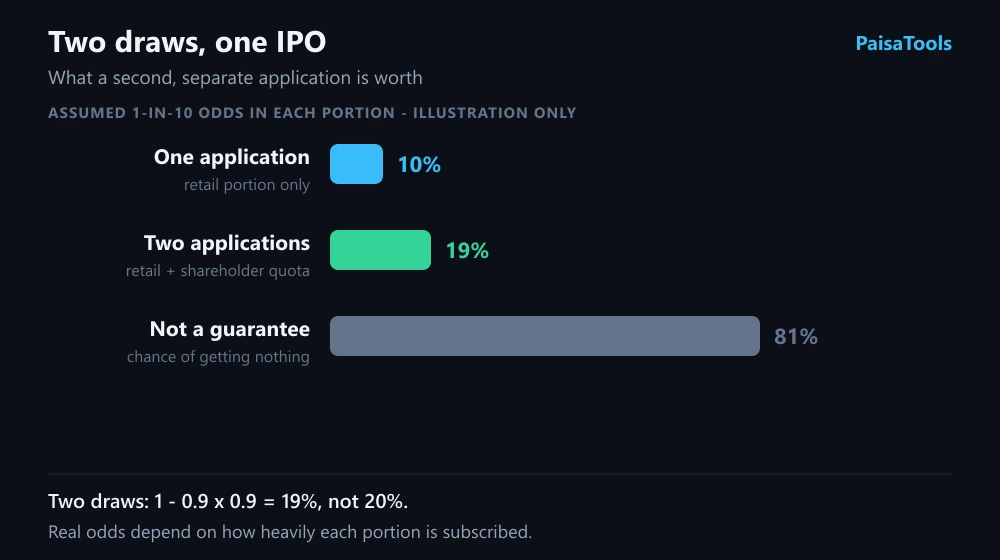
How much that helps depends on the odds in each pool, which nobody knows until the subscription figures come in. As an illustration only: if each pool gave a one-in-ten chance, two independent applications would give about a 19% chance of at least one allotment, not 20%, and not a guarantee. If each gave one-in-twenty, two applications would give about 9.75%.
Should you buy Reliance shares just for the quota?
- The timing is uncertain. Because the cut-off is the RHP date and that date is not announced in advance, a last-minute purchase can simply miss it. Equity trades in India settle T+1, so a share bought today reaches your demat account on the next working day.
- You are buying a large-cap stock, not a ticket. If Reliance falls while you wait, that loss is real money, whatever happens to the IPO.
- Selling later has its own costs: brokerage, a DP charge on the sale, STT, and short-term capital gains tax if you sell at a profit within 12 months.
- The quota only gives you a second draw. It does not promise shares, and an oversubscribed shareholder portion can be just as hard to win as the retail one.
If you already own Reliance shares in your own demat account, the quota is a free extra chance and worth using. If you do not, treat any purchase as an investment decision about Reliance on its own merits, with the quota as a side benefit rather than the reason.
What to check once the RHP is filed
- The size of the shareholder quota and the employee quota, and the exact definition of eligibility on the RHP date.
- The price band and the lot size. Your two ₹2 lakh caps decide how many lots you can bid for in each portion.
- The bid dates. Reported dates of 21 to 23 October with listing around 28 October come from press reports, not from the company.
- Whether your broker's app shows a separate 'shareholder' option. If it does not, you may need to apply through your bank's ASBA facility instead.
If you are new to applying, the step-by-step process is in our guide to applying for an IPO through UPI and ASBA, and our explainer on the grey market premium covers why the number quoted before listing so often misleads.
How to apply for an IPO, step by stepFrequently asked questions
- Is there a shareholder quota in the Jio IPO?
- Yes. The draft red herring prospectus sets aside a 'RIL Shareholders Reservation Portion' for eligible Reliance Industries shareholders. Its size will be stated in the final RHP.
- What is the record date for the Jio IPO shareholder quota?
- Under the draft document, eligibility is tested as at the date of the red herring prospectus, so the RHP date works as the cut-off. That date is known only when the RHP is filed; it has not been announced in advance.
- Can I apply in both the retail and the shareholder category?
- Yes, if you are an eligible Reliance shareholder. The draft document says bids in the shareholder portion and the retail portion are not treated as multiple bids. Each has its own ₹2 lakh limit.
- Do Reliance shares held through a mutual fund count?
- No. The quota is for individuals and HUFs who are public equity shareholders of Reliance in their own name. A fund that holds Reliance is the shareholder, not its investors.
- Does holding Reliance shares guarantee Jio shares?
- No. It only lets you bid in an extra portion. If that portion is oversubscribed, allotment is not assured.