
The leave encashment amount is a single multiplication, and the only real question is whether your company divides by 30 or by 26. The tax is where people lose money. Outside government, only the lowest of four limits is tax-free, and the one that decides it is often not the ₹25 lakh headline. This sheet does the amount both ways and runs the exemption test line by line.
What the sheet does
- Works out the encashment on basic + DA for your unused earned leave, divided by 30 and by 26, and uses the one your company follows.
- Takes your salary for each of the last 10 months and averages it, which is the salary the tax rule uses.
- Counts the leave days the tax rule allows (at most 30 days for each year of service, less leave taken or encashed) and runs all four limits.
- Shows the tax-free part, the taxable part and which limit decided it, for both conventions side by side.
- Handles government employees, encashment during service and exemption already used with an earlier employer.
- A plain .xlsx with no macros, for Excel, Google Sheets and LibreOffice, licensed CC BY 4.0.
The formula, both ways
Dividing by 30 treats every calendar day as a paid day. Dividing by 26 counts working days only, leaving out the four Sundays, so the same leave pays about 15% more. Which one applies is set by your company's leave policy or standing orders, not by the tax law, so check your appointment letter or HR policy before you pick.
The tax rules the sheet uses
- Central or State government employees: leave encashment on retirement is fully exempt.
- Everyone else, including PSU and bank staff, on retirement or resignation: the lowest of (a) the amount received, (b) the earned leave at your credit at the average salary, with no more than 30 days counted for each year of service with that employer, (c) 10 times the average monthly salary, and (d) ₹25 lakh.
- Average salary means the last 10 months before you leave. Salary here is basic pay, DA where it counts for retirement benefits, and commission paid as a fixed percentage of turnover. Other allowances do not count.
- The ₹25 lakh limit applies from 1 April 2023 (it was ₹3 lakh before) and is a lifetime figure across all employers, reduced by any exemption you claimed in earlier years.
- Encashment while you are still in service is fully taxable. Paid to the family after the employee's death, it is fully exempt.
- This was section 10(10AA) of the 1961 Act; in the Income-tax Act, 2025 it sits in section 19, serial numbers 13 and 14 of the table. The new regime keeps it: section 202 blocks only serial number 1 of that table, the deduction for professional tax.
Source: Taxability of retirement benefits: leave encashment (Income Tax Department)
Source: ₹25 lakh limit notified, Notification 31/2023 (PIB, Ministry of Finance, 25 May 2023)
Source: Income-tax Act, 2025, section 19 (Table, serial numbers 13 and 14)
Source: Income-tax Act, 2025, section 202 (new tax regime)
240 days of leave after 20 years, worked through
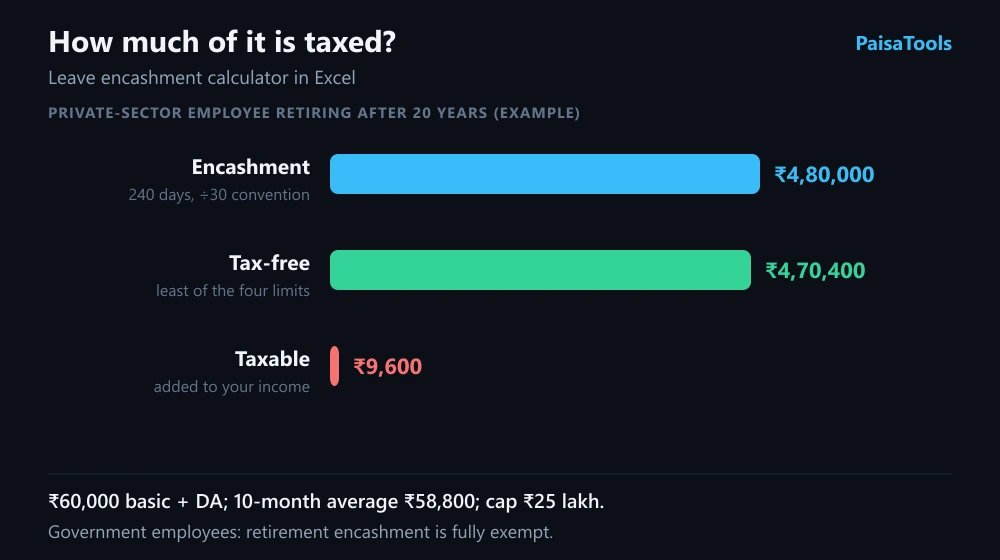
A private-sector employee leaves after 20 years with 240 days of earned leave at credit, having taken 200 days during service. Basic + DA is ₹60,000 a month, after a raise from ₹57,000 six months before leaving, so the 10-month average is ₹58,800.
- Encashment: ₹4,80,000 if the company divides by 30, ₹5,53,846 if it divides by 26.
- Limit (b), the 240 days at the ₹58,800 average: ₹4,70,400. Limit (c), 10 months' average salary: ₹5,88,000. Limit (d): ₹25 lakh.
- Tax-free either way: ₹4,70,400. Taxable: ₹9,600 on the ÷30 amount, ₹83,446 on the ÷26 amount.
Two things show up. All of the extra money from the ÷26 convention is taxable, because the exemption is worked on the average salary, not on your company's divisor. And a raise in the last 10 months pushes the encashment above limit (b), since the encashment uses your last-drawn pay while the tax limit uses the average.
Central or State government employee? Your leave encashment on retirement is fully exempt, with no cap. Set the employer cell to G and the sheet shows the whole amount as tax-free.
Gratuity calculator: the other payout when you leaveWhat the sheet does not do
- It does not work out the tax itself. The taxable part is added to your salary for the year and taxed at your slab.
- It covers earned leave only. Half-pay, sick or casual leave usually cannot be encashed; your policy decides.
- It does not know what an earlier employer exempted. If you encashed leave tax-free on leaving a previous job, enter that amount so the ₹25 lakh limit is reduced.
- Pay that changed month by month needs all 10 months entered; the sample months are placeholders.
Frequently asked questions
- What is the formula for leave encashment in Excel?
- =ROUND(basic_plus_DA/30*days,0), or /26 if your company counts working days. The sheet shows both and lets you pick the one your policy uses.
- How much leave encashment is tax-free for private employees?
- The lowest of the amount received, your earned leave (at most 30 days a year of service) at the 10-month average salary, 10 months' average salary, and ₹25 lakh, which is a lifetime limit across employers.
- Is leave encashment taxable for government employees?
- On retirement, Central and State government employees pay no tax on it at all. Encashment while still in service is taxable for everyone.
- Is the leave encashment exemption available in the new tax regime?
- Yes. The new regime blocks most deductions, but not this one, so the same limits apply in either regime.
- Does the sheet work in Google Sheets?
- Yes. Upload the .xlsx to Google Drive and open it with Google Sheets; the formulas carry over.