
Australia sells itself on two things: universities that rank well, and a post-study work visa that gives a graduate years, not months, to earn in dollars. Both are real. The cost of getting there is also real, and it is shaped by one detail most families notice late — the master's is usually a two-year degree, not the one-year course the UK offers.
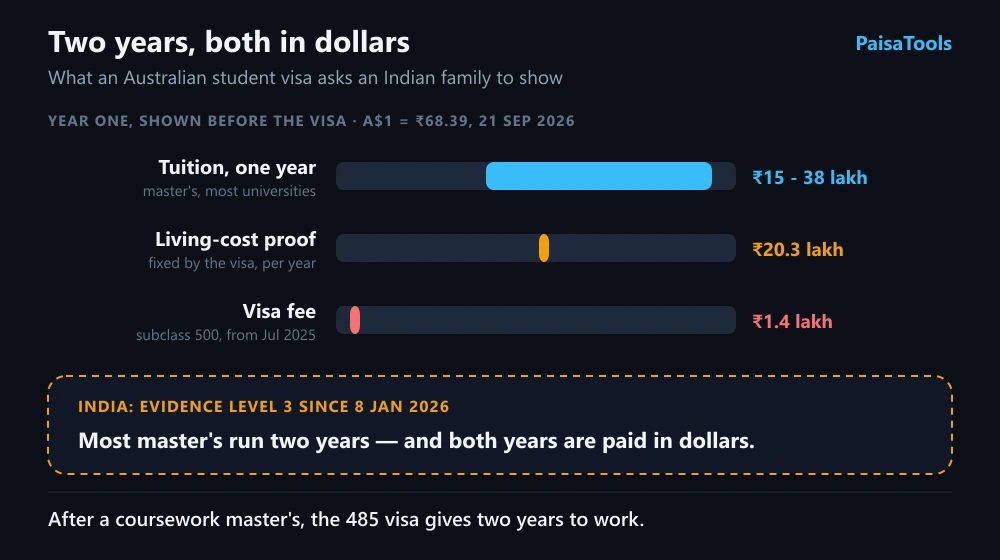
Two years of tuition, two years of living, both priced in Australian dollars. Figures below use the Australian dollar at ₹68.39, the rate on 21 September 2026.
Tuition, by where you get in
- A master's at most Australian universities: roughly AUD 22,000 to AUD 55,000 a year, with a median around AUD 44,000.
- At the Group of Eight — Australia's research-heavy universities — postgraduate coursework commonly runs AUD 42,000 to AUD 55,000 a year.
- An MBA commonly costs more than AUD 60,000 a year, and medicine or engineering at a Group of Eight university can run AUD 60,000 to more than AUD 95,000.
- Most coursework master's run for two years, so the yearly figure is roughly half the bill, not all of it.
Living costs, which the visa fixes for you
Australia does not let you estimate your own living costs. The student visa sets a figure and asks you to prove it, alongside the first year's tuition and your travel.
- For the student: AUD 29,710 a year.
- A spouse or partner adds AUD 10,394, and each dependent child adds AUD 4,449.
- A school-age child adds AUD 13,502 a year for schooling on top of that.
The visa, and the checks India now faces
- The student visa application now costs AUD 2,000 for the main applicant, after the increase on 1 July 2025.
- Overseas Student Health Cover — the compulsory health insurance for international students — must be held for the whole visa, and is bought before the visa is granted.
- Since 8 January 2026, India sits at Evidence Level 3, the strictest document tier. That means detailed proof of funds, where they came from, and a Genuine Student statement that explains why this course makes sense for you.
The practical effect of Evidence Level 3 is timing. Money that arrived last month, a loan still being processed, or a gap nobody can explain cleanly all slow an application down. The families who move smoothly are the ones who arrange the funds, and the paper trail behind them, well before they apply.
What two years actually come to
At the median AUD 44,000 of tuition and the visa's AUD 29,710 of living, the first year the visa asks to see is about AUD 73,710 — roughly ₹50.4 lakh at ₹68.39, before flights. Over a two-year master's, with the AUD 2,000 visa fee, the total comes to about AUD 149,420, which is close to ₹1.02 crore before health cover and travel. And every rupee of it moves with the exchange rate on the day each payment goes out.
Working while studying
A student visa allows up to 48 hours of work per fortnight during study. That is enough to cover part of a student's living costs once a job is found. It does not count towards the money you must show for the visa, and a plan that only works if the job appears in the first month is not a plan.
After the degree: the two-year window
The Temporary Graduate visa gives two years of work rights after a bachelor's or a coursework master's, three after a master's by research, and four after a doctorate. Graduates switch from student health cover to Overseas Visitors Health Cover when they move onto it.
Those two years are the financial case for Australia. They are also the part of the arithmetic that should be tested honestly: if the degree only pays for itself by staying and earning in dollars, the whole decision rests on finding the right job inside that window.
Sending the money, and the tax on doing it
Education remittances above ₹10 lakh a year attract tax collected at source when you fund them yourself, and none when an education loan from a qualifying Indian lender pays. TCS can be claimed back against your own tax, but it is cash that is not available just when the university wants paying.
How TCS on studying abroad works, and how to keep it at zeroThe loan, and the EMI after it
Most families combine savings with an education loan. Test the EMI against a starting salary you would accept in India, not the best case in a brochure — two years of work rights are an opportunity, not a guarantee of a job.
Work out the EMI on the education loan firstCheck whether studying abroad is affordable for youHow it compares
Australia and the USA both usually mean a two-year master's; the UK compresses it into one year but gives a shorter work window after it. Germany charges little or no tuition at public universities. Compare the total outlay against the work rights each country gives you afterwards, not the tuition line on its own.
What studying in the UK costs, in rupeesWhat studying in the USA costs, in rupeesWhat studying in Canada costs, in rupeesFrequently asked questions
- How much money is needed for an Australian student visa from India?
- Enough to cover the first year of tuition, AUD 29,710 of living costs for the student, and travel. Partners and children add their own amounts. Since 8 January 2026 India is at Evidence Level 3, so the funds and their source must be documented in detail.
- What is the Australian student visa fee in 2026?
- AUD 2,000 for the main applicant, following the increase on 1 July 2025. Overseas Student Health Cover for the full length of the visa is a separate, compulsory cost.
- How long is a master's in Australia?
- Most coursework master's run for two years, so the yearly tuition figure is roughly half of the total. Some one-year and one-and-a-half-year programmes exist, usually for students with a related bachelor's degree.
- Can Indian students work in Australia while studying?
- Yes, up to 48 hours per fortnight during study periods. Earnings help with living costs but cannot be counted towards the funds you must show for the visa.
- How long can you stay in Australia after a master's?
- The Temporary Graduate visa gives two years after a bachelor's or a coursework master's, three years after a master's by research, and four years after a doctorate.