
The UK's case against the other destinations is compression. A taught master's takes one year, not two, so the salary you are not earning is halved and you are back in the market a year sooner. That is a real argument, and it is the one every agent leads with.
The same compression is what makes the money hard. A two-year degree is paid across four semesters, and families fund the later ones out of income while the student is already abroad. A one-year degree is effectively one payment cycle, and the visa asks to see almost all of it before the course begins. Figures below use the pound at ₹129.12, the rate on 16 September 2026.
Tuition, by where you get in
- A taught master's at most UK universities: roughly £15,000 to £25,000 for the whole programme, because the whole programme is one year.
- The same at a Russell Group university: roughly £22,000 to £32,000.
- Engineering, computing and the sciences at a Russell Group university: roughly £28,000 to £50,000, where laboratory and clinical teaching costs sit.
- An MBA at a well-known school: above £50,000, and the executive programmes run higher still.
Living, which the visa turns into a fixed number
Most countries leave living costs to your own estimate. The UK does not. The Home Office publishes a maintenance figure, requires nine months of it for a course of nine months or longer, and treats it as a pass-or-fail test rather than a guideline.
- Studying in London: £1,529 a month, so £13,761 has to be shown.
- Studying anywhere else: £1,171 a month, so £10,539 has to be shown.
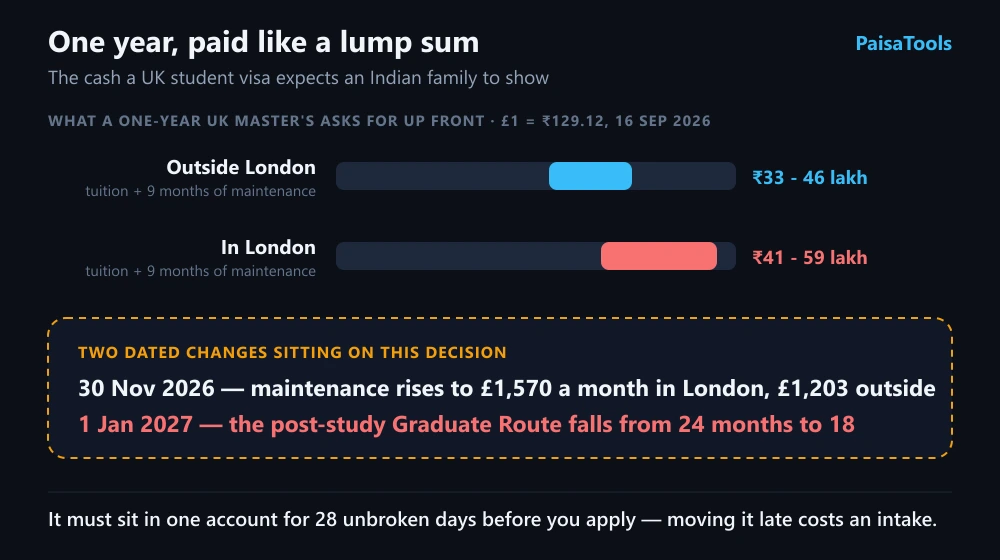
- From 30 November 2026 those rise to £1,570 and £1,203 a month — which changes what an application submitted in December needs versus one submitted in October.
- This is on top of any tuition still unpaid. Money already paid to the university counts against the tuition side, not this one.
The 28-day rule, which is where applications actually fail
The maintenance money must sit in one account for 28 consecutive days, and the closing balance on the statement must be dated no more than 31 days before the application. It can be the student's account or a parent's or guardian's account, with proof of the relationship.
The amount is rarely the obstacle. The stillness is. A balance that dips below the required figure on any one of those 28 days restarts the clock, so money that arrives from a property sale, a matured deposit or a relative in the wrong week costs an intake rather than a fee. Families who read this rule after the offer letter arrives are the ones who defer.
A sanctioned education loan from a recognised lender can be used in place of savings, and for most families that is the cleaner route — it dates and evidences itself, and it removes a tax line covered further down.
The visa stack
- Student visa application: £558 for applications made on or after 8 April 2026.
- Immigration Health Surcharge: £776 a year, paid in full at application rather than monthly. A twelve-month course is normally granted leave of about sixteen months, which makes this roughly £1,164 rather than £776.
- The English test, biometrics and document courier add a few hundred pounds more.
The health surcharge is the line most budgets miss, because it looks like an annual cost and is charged as a single up-front payment covering the whole visa.
What the year actually comes to
A £20,000 master's outside London, with £10,539 of maintenance, the £558 visa and about £1,164 of health surcharge, is close to £32,300 — roughly ₹41.7 lakh at ₹129.12 to the pound, before flights and setting up a room. The same shape in London, at £25,000 of tuition and £13,761 of maintenance, runs near £40,500, or about ₹52.3 lakh. Both figures move with the exchange rate on the day each transfer is made, not the rate on the day the offer arrived.
The Graduate Route just got shorter, and that changes the payback
The post-study work visa has been the financial case for the UK: two years to earn in pounds against a cost incurred in pounds. From 1 January 2027 that falls to 18 months for undergraduate and master's graduates. PhD graduates keep three years.
The cut is timed against course completion, not application, so the September 2026 intake is the last one that finishes in time for the full two years. For anyone starting later, the window in which the degree can pay for itself is a quarter shorter than the version of the arithmetic circulating online.
The practical read: a degree that only works if you stay and earn is now resting on 18 months of permission and a job market you cannot see yet. A degree that is worth taking home to an Indian salary is a different, safer calculation — and the one worth doing honestly before the deposit is paid.
Sending the fees, and the tax on doing it
Education remittances above ₹10 lakh in a financial year attract tax collected at source when they are self-funded, and none when they are funded by an education loan from a qualifying Indian lender. TCS is claimable back against your own tax, so it is a cash-flow cost rather than a loss — but it is cash unavailable exactly when the university wants paying.
How TCS on studying abroad works, and how to keep it at zeroThe quieter cost is the forex markup. Banks commonly build 2 to 3.5 per cent into the exchange rate on an international transfer, taken on every instalment. On a bill this size that markup alone outweighs the visa and the health surcharge together. Compare the quoted rate against the mid-market rate before each transfer, not once at the start.
The loan, and the number that matters more than the fee
Most families fund this with savings plus an education loan. The loan removes TCS on the remittance and its interest qualifies for deduction under Section 80E — section 129 of the Income-tax Act, 2025 — for up to eight years, in the old regime.
What it does not change is the EMI that starts after the grace period. Test that against a starting salary you would accept in India, not the one in the placement brochure, because 18 months of permission is not a guarantee of staying.
Work out the EMI on the education loan firstCheck whether studying abroad is affordable for youHow it compares
The UK is cheaper than the USA in total outlay and shorter by a year, more expensive than Germany by a wide margin, and roughly comparable to Canada once living costs are counted. The comparison that matters is not the fee but the total outlay against realistic post-study earning — including how long each country now lets you stay to do that earning.
What studying in the USA costs, in rupeesWhat studying in Germany costs, in rupeesWhat studying in Canada costs, in rupeesFrequently asked questions
- How much money is needed for a UK student visa from India?
- Enough to cover any unpaid tuition plus nine months of maintenance — £13,761 for London and £10,539 elsewhere at current rates. The maintenance portion must have sat in one account for 28 consecutive days, with the closing balance dated no more than 31 days before the application.
- What is the total cost of a master's in the UK for an Indian student?
- Tuition commonly runs £15,000 to £25,000 for the one-year programme, or £22,000 to £32,000 at a Russell Group university, with maintenance and the visa stack on top. In rupees that puts the whole year somewhere between about ₹33 lakh and ₹59 lakh depending on the university and whether you study in London.
- Is the UK cheaper than the USA for Indian students?
- In total outlay, usually yes, because the master's takes one year instead of two. A US master's commonly totals USD 45,000 to USD 120,000 across two years; a UK master's is one year of tuition plus nine months of living. The gap narrows if you compare against a low-cost US public university.
- What is the 28-day rule for UK student visa funds?
- The required maintenance money must remain in one account for 28 consecutive days without the balance dropping below the figure on any day, and the statement's closing balance must be dated within 31 days of the application. A late transfer or a temporary dip restarts the 28 days.
- How long is the UK post-study work visa now?
- Two years for those who complete their course before 1 January 2027, and 18 months for undergraduate and master's graduates completing on or after that date. PhD graduates continue to get three years. The September 2026 intake is the last that finishes in time for the two-year route.