
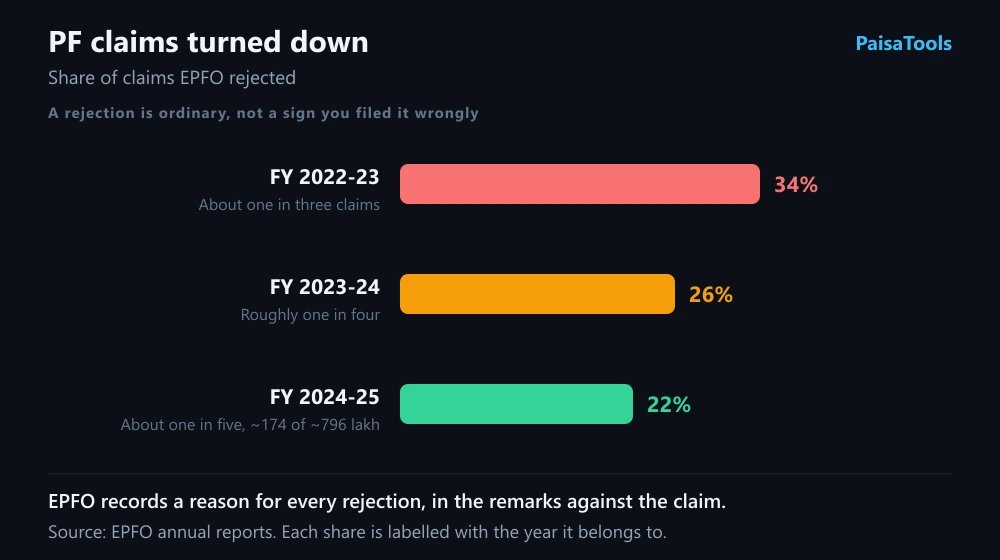
A rejected PF claim is not a rare accident. In its 2024-25 annual report EPFO says members filed about 796 lakh claims and about 174 lakh were rejected — roughly one in five. The rate has been falling (it was near 29% in 2021-22), but at that scale a rejection is an ordinary Tuesday, not a sign you did something unusual.
The frustrating part is that the rejection notice itself usually says nothing useful. The SMS tells you the claim was rejected. It does not tell you why, and the fix depends entirely on the why — some reasons need a fresh form, some need your employer, and one of them means the money was never payable to you in the first place.
Where the actual reason is written
EPFO does record a reason, in a field most members never open. Log in to the member portal with your UAN, go to Track Claim Status, and read the remarks against that claim. That remarks line is the whole diagnosis — everything below is how to read it.
Do this before you refile. Submitting the same claim again without reading the remark is the single most common way people turn one rejection into three, and each round costs another 15-20 days.
"Insufficient member service" — the one that confuses everyone
This is the most-searched rejection remark, and it is also the most misread. It does not mean your PF is gone, and it usually does not mean you filed anything wrongly.
It refers to the pension side, not the provident fund side. EPS withdrawal on Form 10C needs at least six months of contributory service. Under six months, Form 10C is correctly rejected — but your EPF corpus on Form 19 is unaffected and remains claimable. If you filed both together, the Form 19 leg is the one to pursue.
The other remarks, and what each one actually needs
- Name, date of birth or father's name differs from Aadhaar: a single letter is enough. This is a joint declaration corrected with your employer, not a refiling — refiling first just repeats the rejection.
- KYC not verified or not approved by employer: your bank account, PAN or Aadhaar is sitting unapproved on the employer's side. It is their digital signature that clears it, so this one is a phone call to HR, not a form.
- Bank account details wrong or account closed: extremely common for anyone who switched banks after leaving a job. The account must be seeded and verified against the UAN before the claim will pass.
- Date of exit not updated: if the employer never marked your exit, a final settlement cannot be processed. Members can now mark date of exit themselves on the portal after two months from leaving.
- Claim not admissible under the scheme applied for: you asked for a withdrawal the scheme does not allow at that point — the wrong advance reason, or a final settlement while still employed.
- Rejected without a stated reason: this happens, and it is not a dead end. It goes to the grievance route below.
If the remark is wrong, or there is no remark
EPFO runs its own grievance portal, EPFiGMS, and a claim rejected without a valid reason is exactly what it is for. Register the grievance against the office holding your account, attach the claim ID, and quote the remark you saw (or its absence). If that stalls, the matter escalates to the Regional Provident Fund Commissioner for that office.
Keep the claim ID and the rejection date from the Track Claim Status screen. Every escalation asks for both, and the screen is the only place they exist.
Check where your money actually standsFrequently asked questions
- Does a rejected PF claim mean I lose the money?
- No. A rejection is a processing outcome, not a forfeiture — the balance stays in your account and continues to earn interest until a valid claim is settled.
- How long should I wait before refiling?
- Read the remark first, fix the underlying cause, then refile. Refiling without a fix reproduces the same rejection and costs another cycle of 15-20 days.
- Can I still claim my EPF if I left the job very early?
- The EPF corpus on Form 19 does not have a six-month bar. The six-month requirement applies to EPS withdrawal on Form 10C, which is what an "insufficient member service" remark is usually about.
- Who fixes a name or date-of-birth mismatch?
- It is corrected through a joint declaration with your employer, because the correction has to be attested on their side before EPFO will accept it.